Benchmarking Physical Agency

What range of physical goals can today’s Embodied AI systems achieve autonomously? WorldLeague compares them on 60 simulated robot tasks by measuring progress toward each task’s physical goal from the robot’s trajectory.

Xinyang Zhou, Qi Li, Xinchao Wang†

xML Lab · National University of Singapore † Corresponding author

3 leaders across 6 capabilities

Interactive Score across all 13 models, on a shared 0–50 scale. Colored dots mark the leaders. Sol and Astra tie in constraint management. Explore the leaderboard.

Different capabilities have different leaders

FableSolAstra

8.5% physical success Mean QA 73.3/100

Each VLM ran the same 60 tasks. Terminal QA scores its answers about each episode. Physical success requires the full goal and all constraints to hold. The models achieved the goal in 41 of 480 episodes. In 249 episodes they answered every question correctly and earned zero Interactive Score.

Physical goals often go unmet even with perfect answers

VLMPhysical successQA /100

1/38 deliveries met the full goal

Across 16 of the 59 shared tasks, at least one model made progress and none met the full goal. Each square here is one mirror-guided rearrangement attempt. The object reached its destination in 38 of 39 attempts. Only Fable on R-S1 also achieved the requested spatial relation and left the object stable after release.

Successful actions can still leave the physical goal unmet

Arrived onlyArrangement heldMissed

Fable earned 4.5× Qwen’s score

Fable and Qwen both averaged about 51 minutes per task. Fable earned an Interactive Score of 28.58 using 3.07M tokens per task. Qwen earned 6.31 using 6.47M. The gold line connects the Pareto frontier for the selected resource. Time is available for all 13 models and token counts for the eight VLMs.

Similar runtimes can yield very different physical progress

ScorePareto frontier

Leaderboard

Select an Embodied AI system to see its Physical Agency Profile. Each dimension pairs mean Interactive Score with physical success rate.

Model family
RankEmbodied AI system
1Claude Fable 5.2VLM · 60 tasks28.5821.67%
2GPT-6.1-SolVLM · 60 tasks22.2815.00%
3GPT-6-AstraVLM · 60 tasks20.0613.33%
4DeepSeek-V4.1-FlashVLM · 60 tasks11.868.33%
5Kimi-K3.1-ProVLM · 60 tasks9.083.33%
6GR00T-N1.5VLA · 59 tasks8.795.08%
7π0.5 (R1Pro SFT)VLA · 59 tasks8.115.08%
8Awomo-0.5IWAM · 59 tasks6.753.39%
9Qwen3.8-27BVLM · 60 tasks6.313.33%
10Gemini-Decision-1VLM · 60 tasks5.471.67%
11Jev-1.14.0VLM · 60 tasks4.641.67%
12OpenWAM-AlphaWAM · 59 tasks3.810.00%
13Xiaomi XR-1VLA · 59 tasks2.820.00%
Select a bar to rank by domain. WorldSeek WorldShape WorldShift

WorldLeague Benchmark

Physical goals and task demands

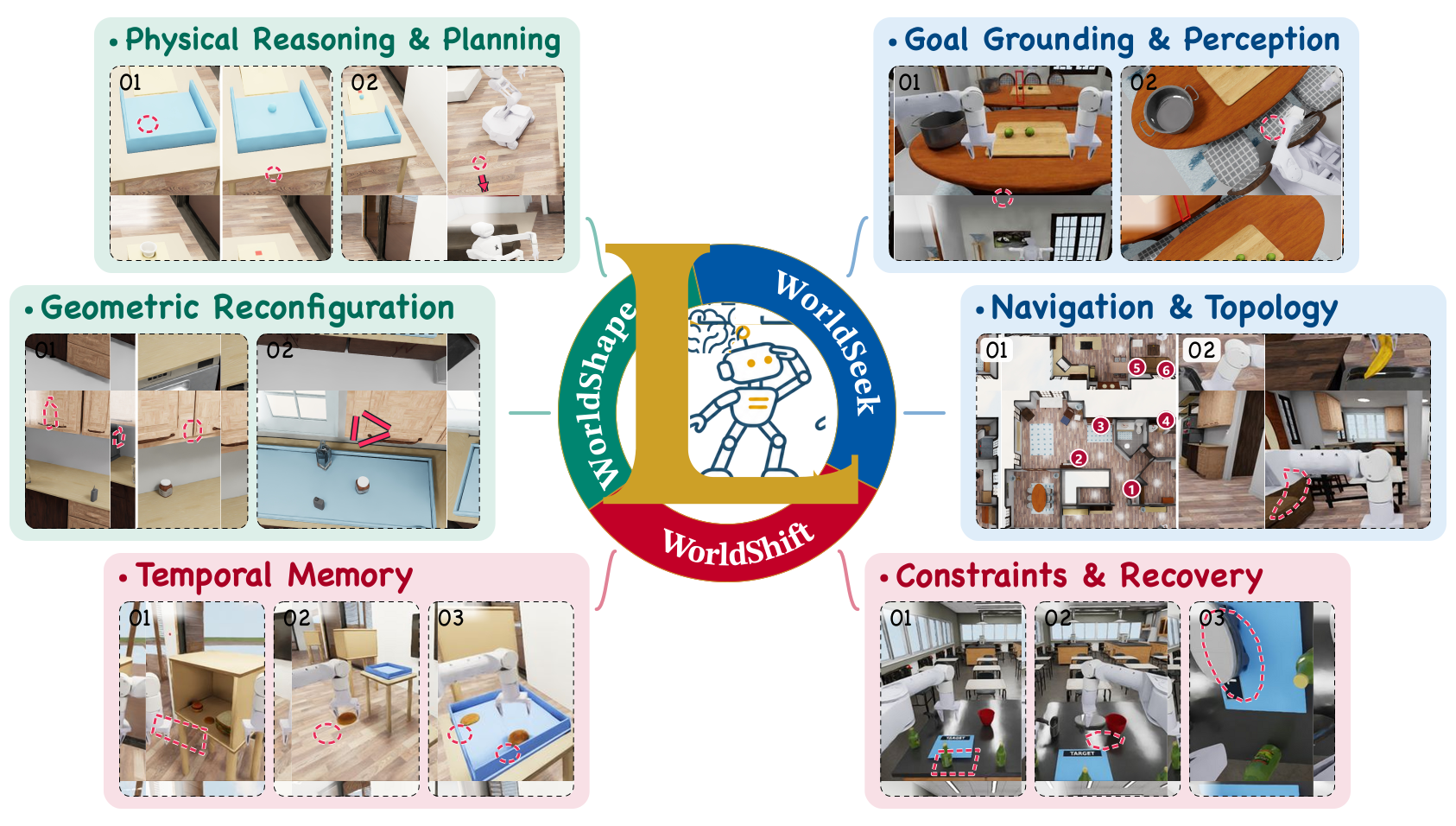
Robots explore scenes to gather evidence in WorldSeek, rearrange objects in WorldShape, and adapt to changes in WorldShift.

WorldSeek

  • Where the robot goes determines what it can reach and what it can see.
  • In a WorldSeek task, the robot may need to
    • plan routes to destinations or viewpoints
    • gather evidence to identify a target
22 tasks · Navigation & Grounding

WorldShape

  • How the robot reshapes its surroundings determines what it can build and what will hold after it lets go.
  • In a WorldShape task, the robot may need to
    • arrange objects in a required spatial relation
    • reason about motion, contact, and support
24 tasks · Geometry & Physics

WorldShift

  • What the robot sees and remembers determines which changes it can recognize and how it can adapt its plans.
  • In a WorldShift task, the robot may need to
    • interpret changes or requests using earlier observations
    • maintain or restore required conditions
14 tasks · Memory & Constraints
Example tasks across six dimensions in WorldSeek (blue, right), WorldShape (green, left), and WorldShift (red, below).

Scoring physical goals

For each task, the robot’s trajectory shows which goal requirements it satisfies and whether it completes the task. We compute the Interactive Score as the mean credit across goal items, scaled to 100. Physical success requires satisfying the full goal and all task constraints.

The interface

WorldHarness

Decision-preserving action abstraction

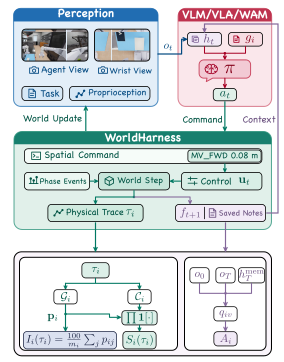
WorldHarness implements this abstraction on R1 by adapting Show-Harness. Given the public goal, camera observations, and retained history, the vision-language model (VLM) selects a base, arm, trunk, or gripper command. The controller executes the motion and returns feedback, which the VLM can use to revise its next command.

Vision-language-action models (VLAs) and world-action models (WAMs) use their native controls. All three model families share the task goals, constraints, and physical scoring rules.

WorldHarness repository

WorldHarness executes VLM commands and returns observations and feedback. The evaluator scores physical outcomes and terminal QA separately.

Evaluation

Evaluate your model

Start with the task catalogue on CPU. For an R1 episode, use the OmniGibson simulator environment with the licensed BEHAVIOR assets.

Get the benchmark

git clone https://github.com/xyangzhou/WorldLeague
cd WorldLeague
python -m pip install -e .
git clone https://huggingface.co/datasets/xyangzhou/WorldLeague benchmark
worldleague tasks

Run a VLM episode

worldleague eval T04 --config luna-medium \
  --gpu 0 --output runs/luna/T04

Install the sibling WorldHarness checkout and set the preset’s API key first. Simulator setup

Read the profile

worldleague profile runs/luna

To connect a new model, robot or harness, follow the contribution guide.

Citation

Cite WorldLeague

BibTeX

@misc{zhou2026worldleague,
  title  = {{WorldLeague}: Benchmarking Physical Agency},
  author = {Zhou, Xinyang and Li, Qi and Wang, Xinchao},
  year   = {2026},
  url    = {https://github.com/xyangzhou/WorldLeague}
}

Physical Agency Profile

CapabilityScoreSuccess